
December 24, 2025
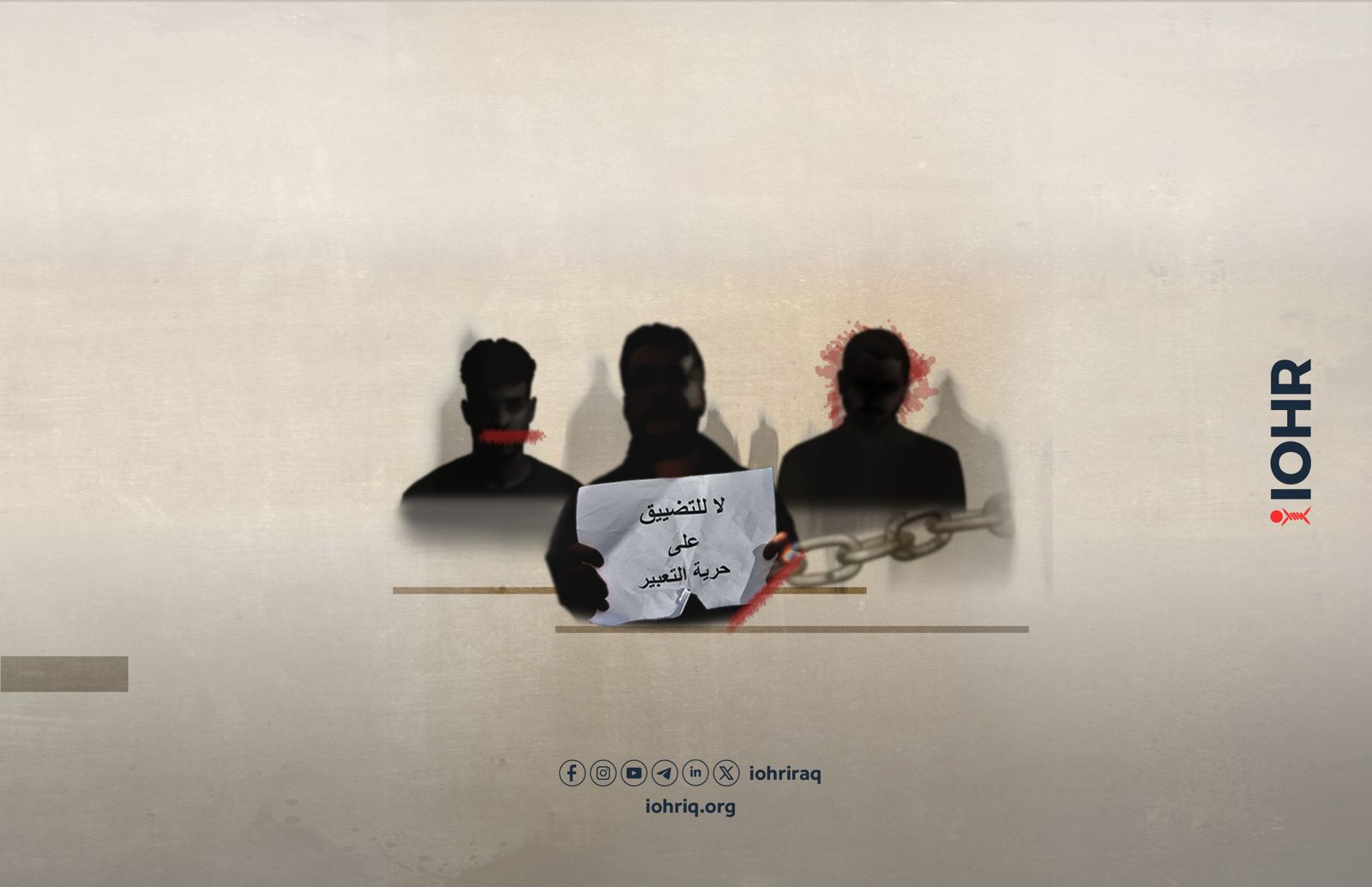
The Iraqi Observatory for Human Rights (IOHR) stated that recent developments in several Iraqi governorates reveal a deeply concerning trajectory toward increasing restrictions on freedom of expression. This trend is marked by the use of legal, judicial, and administrative tools to punish peaceful opinion, human rights advocacy, workplace criticism, and political expression—signaling a serious regression in constitutional guarantees of public freedoms.
IOHR considers that these cases, despite differing in context and actors, cannot be viewed as isolated incidents. Taken together, they constitute a recurring pattern that reflects a structural flaw in how freedom of expression is understood and applied within state institutions, as well as in the relationship between authority and public opinion. This pattern indicates a gradual shift from protecting expression to penalizing it.
Basra: Reopening a Closed Case and Using the Law as a Deterrent Tool
In Basra Governorate, IOHR documented the arrest of Ali Al-Abbadi, Director of the Iraq Center for Human Rights, after he reported to the National Security Service, where he was informed of an arrest warrant issued against him under Article (433) of the Iraqi Penal Code. According to Al-Abbadi, the complaint was filed by the 41st Brigade of the Popular Mobilization Forces (PMF) over the circulation of a plea by an individual alleging that he had been subjected to torture. Al-Abbadi confirmed that the case had been legally closed in February 2025, only to be reactivated later without the announcement of new judicial grounds or newly established facts.
IOHR notes that reopening cases that have already been legally settled undermines one of the most fundamental principles of criminal justice: the stability of legal positions, which is meant to protect individuals from repeated prosecution for the same act. The Observatory further stresses that invoking Article (433), which addresses defamation and insult, in contexts involving the transmission of allegations of torture or potential human rights violations raises serious legal concerns. International human rights standards consistently emphasize that expression related to matters of public interest must enjoy enhanced protection, and that any disputes—if warranted—should be addressed through civil, not criminal, proceedings.
In this context, Mustafa Saadoon, President of the Iraqi Observatory for Human Rights, stated:
“What we are witnessing today is an expansion in the use of criminal law tools to punish opinion rather than to remedy actual harm. The problem is no longer the absence of constitutional guarantees, but how laws are interpreted and deployed as instruments of deterrence.”
He added: “Reactivating closed cases sends a dangerous message to human rights defenders and journalists alike—that a legal resolution does not necessarily mean the end of risk".
Administrative Sanctions: When Workplace Criticism Becomes an Offense
In a different track—less severe in form but no less dangerous in substance—IOHR monitored the imposition of an administrative penalty against employee Aqeel Al-Rashed, following a Facebook post in which he criticized delays in the payment of hazard allowances at the Ibn Majid State Company, as well as disparities in benefits among employees.
IOHR considers that punishing an employee for expressing workplace grievances or criticizing administrative policies constitutes a violation of freedom of expression within the work environment. Such practices transform public institutions into closed spaces intolerant of criticism, undermining the principles of transparency and accountability that should govern public administration.
A human rights activist commented in this regard:
“Punishing employees for their opinions—even when directly related to their labor rights—pushes everyone toward silence and entrenches a culture of fear within institutions.”
He added: “The danger lies not only in the decision itself, but in the message it sends: remain silent or face consequences".
Baghdad: Political Opinion Before Criminal Courts
In Baghdad, the issue of freedom of expression took on a clearer judicial dimension following the issuance of a three-year prison sentence against academic Diaa Al-Azawi and his colleague Sinan Al-Shammari, over a statement in which they expressed political positions calling for the restoration of sovereignty and rejection of foreign interference. IOHR stresses that this ruling has sparked widespread concern among legal and rights-based circles, given its implications for the criminalization of political opinion and the absence of a clear boundary between constitutionally protected expression and acts deemed criminal under the law.
An Iraqi journalist noted:
“The problem is no longer limited to the issuance of verdicts, but to the absence of clear standards. No one knows where their right to expression ends and legal risk begins.”
He added: “This ambiguity itself has become a tool of intimidation, driving journalists and activists toward self-censorship.
Constitutional and International Framework: Rights Stripped of Substance
IOHR recalls that Article (38) of the Iraqi Constitution explicitly guarantees freedom of expression by all means. Iraq is also a State Party to the International Covenant on Civil and Political Rights (ICCPR), particularly Article (19), which protects freedom of opinion and expression and permits restrictions only under strict conditions of necessity and proportionality, without impairing the essence of the right. Interpretations issued by the UN Human Rights Committee further affirm that political expression—even when sharp or critical of authorities—must receive the highest level of protection.
IOHR concludes that current developments reflect an expanding reliance on state mechanisms to punish peaceful expression, whether through arrest warrants, administrative sanctions, or custodial sentences. This practice transforms legal provisions from safeguards of public order into tools of silencing, producing a public environment governed by fear and self-censorship.
Broader Impact on Society and the State
IOHR warns that the continuation of this approach harms not only the individuals directly affected, but society as a whole. It weakens civil society, restricts public debate, and empties professional and media spaces of constructive criticism—undermining the foundations of any genuine democratic process.
Wissam Al-Mulla, Media Advisor to IOHR, stated:
“Every day that passes without addressing these cases sends a dual message: fear to those who wish to speak, and reassurance to those who use influence to silence others".
He added that “the excessive use of judicial and administrative measures in opinion-related cases erodes public trust in institutions rather than strengthening it".
IOHR Position
The Iraqi Observatory for Human Rights affirms that freedom of expression is not measured by the number of media outlets or social media platforms available, but by the extent to which individuals are protected from persecution when they use these platforms to peacefully express their views or demand their rights.
IOHR calls on judicial authorities to review these cases in accordance with fair trial standards and to ensure that criminal laws are not used to punish lawful expression. It also urges the executive and legislative authorities to review vague legal provisions that are exploited to criminalize opinion, and to align national legislation with Iraq’s international human rights obligations.
IOHR concludes by emphasizing that freedom of expression is not a privilege granted at the discretion of the authorities, but an inherent right of every citizen. Undermining this right through judicial or administrative action constitutes a serious indicator of the erosion of the rule of law and sends a dangerous message to society—that expression may be met with punishment rather than protection.