
This statement addresses the escalating risks faced by civilians in Iraq due to regional tensions and the proliferation of weapons within cities, including the storage of armaments in residential neighborhoods and the crashing of drones over populated areas. It reviews documented incidents resulting in civilian casualties, calling on the government to protect the population, conduct transparent investigations, and hold those responsible accountable.
March 12, 2026
The Iraqi Observatory for Human Rights (IOHR) expresses its profound concern over the rapidly accelerating security escalation in Iraq, amid increasing indicators that the country is being transformed into an open arena for settling regional accounts. This trajectory threatens the lives of civilians and places millions of Iraqis in a direct circle of danger, following long decades of wars and conflicts whose impacts remain present in both society and infrastructure.
The Observatory stated that civilians in Iraq, who have yet to catch their breath from the legacy of wars, find themselves once again at the forefront of threatened groups, exposed to a real risk affecting their natural right to life and personal safety—a right guaranteed by the Iraqi Constitution and reaffirmed by international human rights conventions.
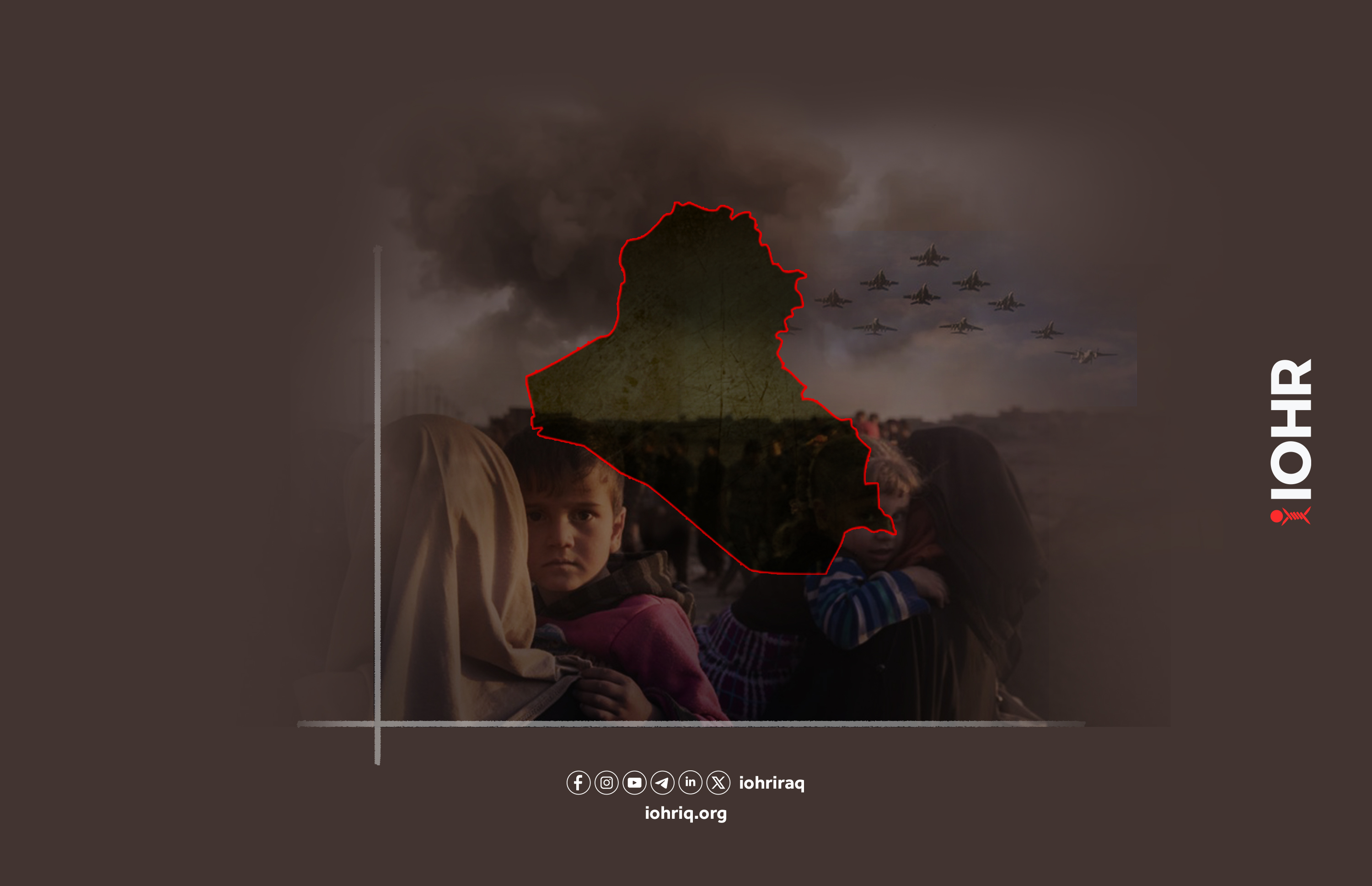
Iraq stands today at a sensitive juncture, given the escalation of regional tensions and increasing signs of a potential expansion of conflict in the region. The current scene raises growing alarm with the repeated crossing of warplanes, missiles, and drones through Iraqi airspace, at a time when weapons are proliferating outside the state’s framework and military depots exist within residential neighborhoods, thereby doubling the risks to civilian lives.
The Observatory believes that transforming residential areas into de facto military sites—whether through storing weapons or launching and intercepting drones over cities—constitutes a clear violation of the rules of International Humanitarian Law, which obligates all parties to take necessary precautions to protect civilians during armed conflicts.
On March 11, 2026, the Observatory documented the killing of a woman in Al-Suwaira District, Wasit Governorate, resulting from explosions caused by a US-Israeli strike on a weapons depot belonging to the 41st and 42nd Brigades within the Popular Mobilization Forces (PMF).
According to information obtained by the Observatory, the strike led to violent secondary explosions inside the depot, causing shrapnel and projectiles to fly toward adjacent residential neighborhoods, resulting in the death of the woman inside her home and the critical injury of her son.
The Observatory also monitored, during March 2026, repeated incidents of drones or their debris falling within crowded neighborhoods in Baghdad, causing material damage and panic among residents.
On March 9, drone debris fell near a house in the Al-Ilam neighborhood after being intercepted near the Victoria Base, leading to a fire inside the residence. Similarly, on March 11, similar incidents occurred in the Al-Jihad neighborhood and the Al-Dora area, where civilian homes and vehicles were damaged as a result of falling drones or debris.
The Observatory views these incidents as a reflection of a dangerous level of risk exposed to civilians by transforming cities into a space for military conflict, whether through attacks or aerial interception operations.
The Iraqi Observatory for Human Rights stated that Iraq is still undergoing a fragile recovery phase after long years of conflict, particularly the war against the "ISIS" organization, which left behind destroyed cities, exhausted infrastructure, and communities still suffering from the effects of displacement and human losses.
In light of the economic and environmental challenges facing Iraq, including the impacts of climate change, drought, and increasing economic pressures on vulnerable groups, any new escalation may double the burdens on society and return the country to cycles of instability.
The Observatory also called on the Iraqi government to take clear steps to neutralize the country from regional conflicts and to work toward preventing cities and civilian infrastructure from being turned into battlefields.