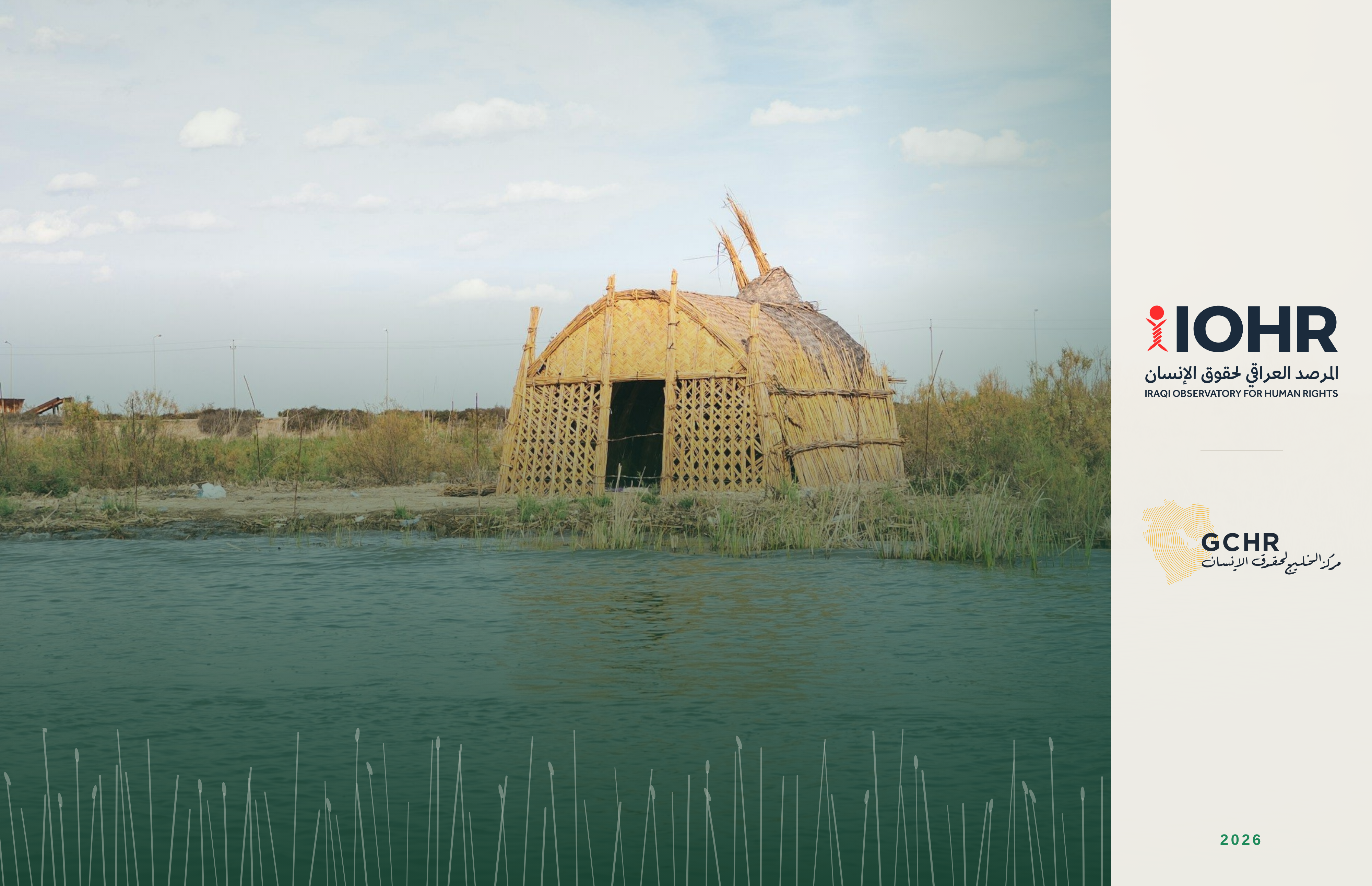

The Iraqi Observatory for Human Rights (IOHR), in partnership with the Gulf Centre for Human Rights (GCHR), has published a field study by researcher Manar Al-Zubaidi on what the drying of the marshes has done to women’s lives in southern Iraq. It draws on 22 documented field interviews in Basra, Dhi Qar and Maysan, cross-checked against official statistics.
The three main marshes shrank from 8,926 square kilometres in the 1970s to 2,516 in 2010. They partly recovered, but the 2022 drought dried out 98% of the Hawizeh marsh. As the water went, farming, fishing, buffalo herding and reed crafts collapsed together, and women carried most of that work.
The study finds that the loss did not fall equally. A man who loses a livelihood still has options, such as moving to the city or taking paid work. A woman loses the resource, her way of life and her standing all at once, and she does not have the same options.
Key findings:
Economy: Rural women’s recognised economic activity rate is 8.6%, against 74.1% for men, because official statistics do not count their unpaid work.
Health: 83.7% of recorded miscarriages in Maysan have no identified cause, and recorded cancer cases in Basra rose from 500 to 1,600 between 2016 and 2019. Lower water flows concentrate pollutants, and lead and cadmium levels exceed permitted limits.
Displacement: The number of households displaced by climate in central and southern Iraq nearly doubled in twelve months, from 12,212 to 23,364. Gradual and seasonal displacement is not recorded at all.
Society: Three in ten girls in Maysan are married as minors, the highest rate in Iraq. Illiteracy is 27.3% among rural women, against 14.7% in cities.
The study identifies four structural mechanisms that turned the drought into a double loss for women: limited access to finance and productive resources, a statistical system that does not see their work, tribal and legal barriers to redress, and gaps in health, education and protection services. It closes with ten recommendations for decision-makers, covering women’s role in water management and negotiation, finance and compensation, legal protection, and the production of sex-disaggregated data.
📄 تحميل الدراسة كاملة بالعربية · Download the English edition