
November 2, 2025
The Iraqi Observatory for Human Rights (IOHR) warns that impunity for crimes committed against journalists in Iraq remains pervasive and deeply entrenched, reflecting a structural failure to protect press freedom and uphold the rule of law.
Despite constitutional guarantees, domestic legislation, and binding international obligations, journalists in Iraq continue to face targeted violence—including extrajudicial killings, threats, torture, enforced disappearance, arbitrary detention, and professional obstruction—without meaningful accountability.
IOHR affirms that the persistent absence of justice not only violates the right to freedom of expression, but also weakens public trust in state institutions, erodes civic space, and threatens Iraq’s already fragile democratic environment.
Journalist Omar Al-Jaffal noted: “When a journalist is killed, the loss is not only personal—it is the loss of a society’s memory and voice.”
This year, as Iraq marks the International Day to End Impunity for Crimes Against Journalists, the country continues to experience one of the most dangerous climates for media work worldwide. Journalists operate in a space where constitutional promises collide with harsh realities on the ground, and where seeking or reporting the truth can carry fatal consequences.
Although Article 38 of the Iraqi Constitution guarantees press freedom, and Iraq is a State Party to the International Covenant on Civil and Political Rights (ICCPR)—as well as bound by UN Security Council Resolution 1738 on the protection of journalists—these commitments remain largely unenforced. Perpetrators of violence against journalists routinely escape accountability due to political interference, intimidation, unreliable investigative procedures, and the absence of independent oversight mechanisms.
Since 2003, more than 475 journalists and media workers have been killed in Iraq, according to national and international monitoring bodies. Yet only a handful of cases have resulted in prosecution. This staggering impunity reflects a climate where truth is endangered, and where fear and silence replace transparency and public scrutiny.
Journalist Ziad Al-Ajili said: “Each day without accountability tells journalists to stay silent, and tells perpetrators they may continue.”
The unresolved killings of journalists remain emblematic of the state's failure to deliver accountability.
In February 2006, journalist Atwar Bahjat was killed in Samarra after covering the bombing of the Al-Askari Shrine. Her reporting was known for resisting sectarian polarization; her murder silenced a critical, balanced voice. No transparent investigation has ever been made public.
In May 2010, Kurdish journalist Sardasht Osman was abducted outside his university in Erbil and found dead days later in Mosul, bearing signs of torture. Osman had written about corruption and abuses of power. His family continues to seek justice, with no perpetrator held to account.
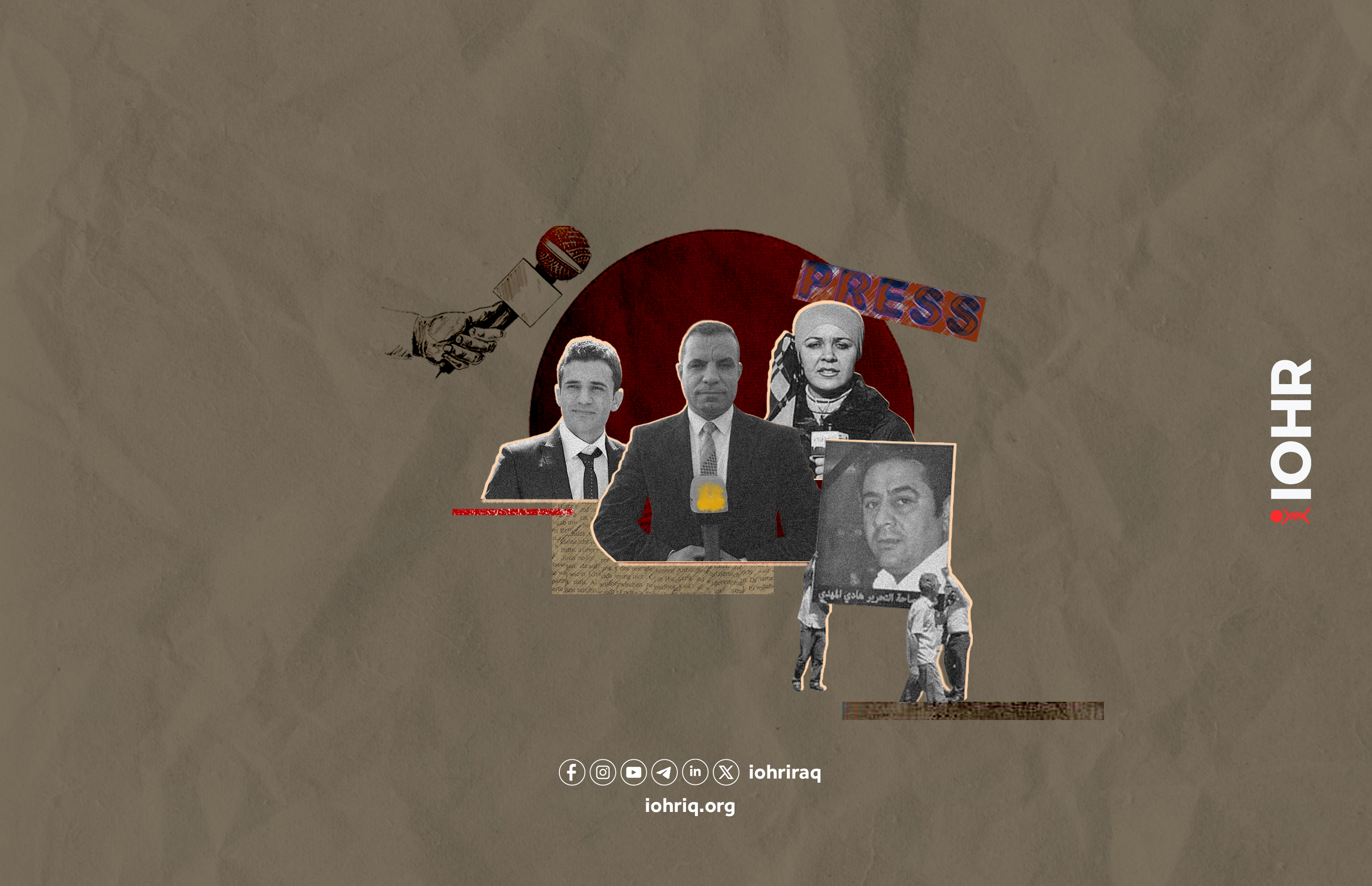
In September 2011, journalist and activist Hadi Al-Mahdi was shot dead inside his Baghdad home after publicly reporting threats. Despite the public outcry, his case faded without resolution.
In January 2020, journalist Ahmed Abdul-Samad and cameraman Safaa Ghali were shot dead while covering protests in Basra. Their killing was captured on video, yet investigations stalled, leaving the question unanswered: Who killed the truth in Basra?
Recent testimonies collected by IOHR show that risks remain widespread.
A freelance cameraman described how security forces seized his camera: “They treated it like a weapon. In Iraq, holding a camera can be a crime.”
Such accounts are not isolated—they reflect a consistent pattern of targeted violence, failed investigations, intimidation of witnesses, and files closed as “against unknown persons,” a phrase that has become synonymous with impunity.
The United Nations and UNESCO have repeatedly warned of Iraq’s deepening accountability crisis. UNESCO, in its most recent statement, announced plans for a 2025 cooperation framework with Iraq’s judiciary to strengthen legal protections for freedom of expression. The organization reported that over 500 journalists have been killed since 2003 and that impunity exceeds 98%, urging Iraq to reactivate the investigative unit for journalist killings and publicly disclose investigative outcomes.
Mustafa Saadoon, Head of IOHR, said:
“A state cannot claim adherence to the rule of law while journalists are killed with no accountability. Silence does not preserve stability—it empowers perpetrators. Iraq must reopen these cases and build mechanisms that prevent a journalist’s pen from becoming a death sentence.”
He added:
“The challenge is not in the legal framework, but in enforcement and political will. Iraq needs independent investigative units, witness-protection programs, and full transparency.”
IOHR Media Advisor, Wissam Al-Mulla, stated:
“Every day without justice sends a message of fear to journalists and reassurance to their killers. Impunity is not only a crime against the press—it is a crime against the public’s right to truth.”
Journalist Sajjad Al-Jubouri commented: “Threats alone today are enough to silence journalists. The danger is not only in murder—it is in the fear that impunity creates.”
IOHR emphasizes that protecting journalists is a constitutional and moral duty—not a political gesture. Iraq must establish independent judicial processes, reopen all unresolved cases, enforce witness-protection mechanisms, reactivate the specialized investigative unit on journalist crimes, and regularly disclose investigative progress.
Journalist Omar Al-Jaffal noted: “When a journalist is killed, the loss is not only personal—it is the loss of a society’s memory and voice.”
In Iraq today, press freedom is tested not only in newsrooms but in courtrooms, police stations, and institutional silence. Delayed justice is not a procedural gap—it is an existential threat to the rule of law and a clear signal that truth remains a target.