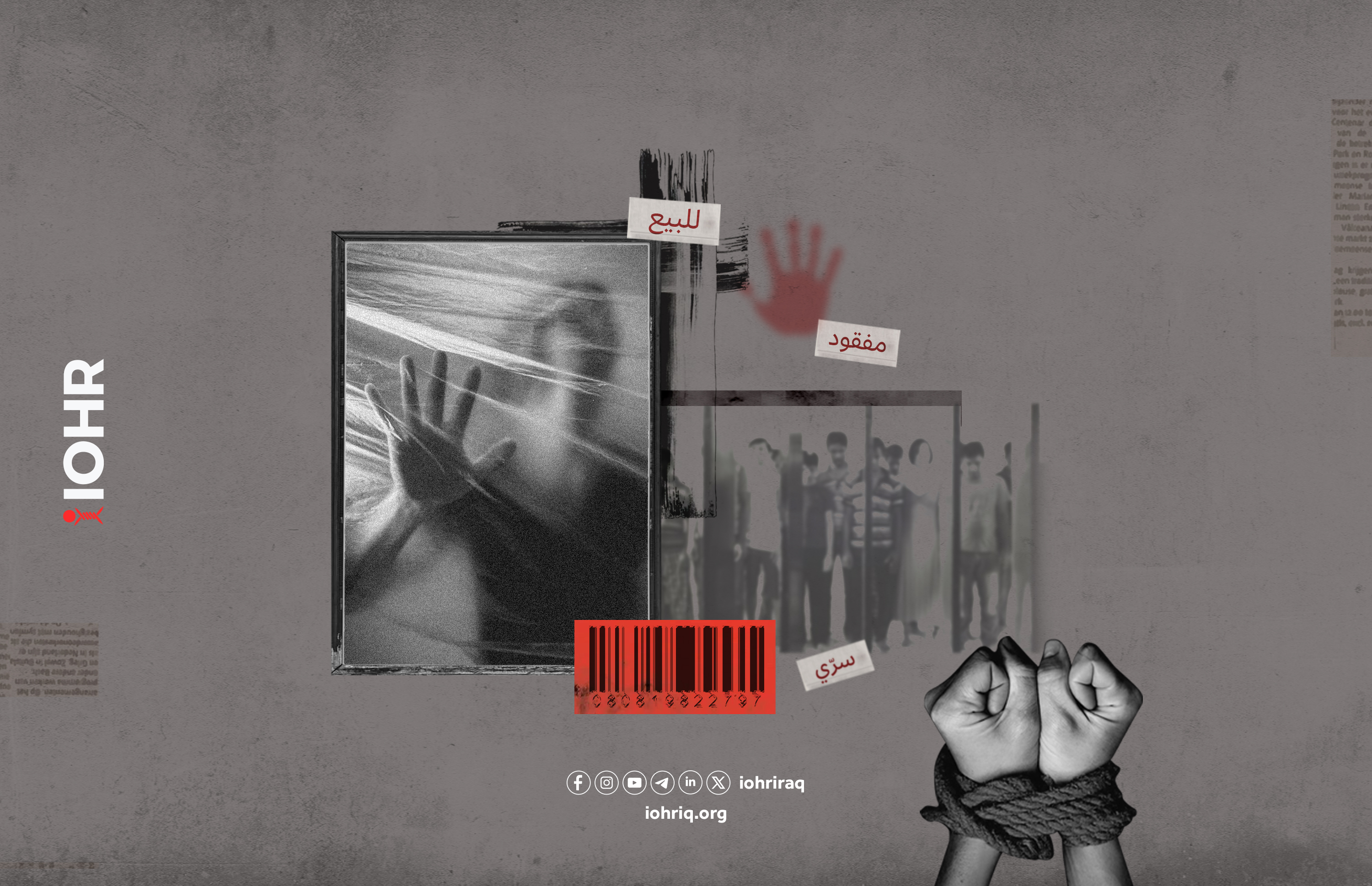

This release is a summary of a forthcoming study, “The Architecture of Exploitation and the Justice Gap,” to be published by the Iraqi Observatory for Human Rights (IOHR). All national statistics cited here relate exclusively to the year 2025.
July 19, 2026
The Iraqi Observatory for Human Rights (IOHR) said on Monday that a total of 5,107 individuals were detained in human trafficking cases in Iraq during 2025, while only 385 victims were formally identified and documented over the same year — a figure equivalent to just 7.5 per cent of those detained, or roughly one documented victim for every thirteen detainees.
(IOHR) said these figures form a summary of a forthcoming expanded study, “The Architecture of Exploitation and the Justice Gap,” which analyses official statistical indicators issued by security and judicial authorities within the Ministry of Interior for 2025, situating them within Iraq’s national legal framework and international obligations, alongside direct field testimonies from survivors.
The Iraqi context: a fragile environment and organized networks
(IOHR) said human trafficking in Iraq cannot be read in isolation from the profound transformations the country has undergone since 2003, accompanied by the weakening of state institutions, escalating armed conflict, widespread internal displacement, and rising unemployment and poverty, as well as the expansion of local and cross-border organized crime networks. Together, these factors have created an environment conducive to the exploitation of human beings as an economic resource.
It added that trafficking in Iraq is no longer practised as an isolated individual crime, but has become an organized enterprise run by networks capable of recruitment, transport, concealment, exploitation, and the laundering of proceeds — exploiting legislative and procedural gaps, weak oversight, administrative corruption, and the difficulty victims face in accessing justice.
According to (IOHR), these networks operate through a complete criminal cycle: recruitment through fraudulent job advertisements or promises of travel or marriage; followed by transport and harbouring; then the imposition of control through confiscation of identity documents, artificial debt bondage, isolation from family and community, and threats of violence; culminating in exploitation for financial gain.
(IOHR) stressed that the most vulnerable groups remain the most exposed to these networks — women, children, internally displaced persons, refugees, migrant workers, and persons with disabilities — noting that such crimes constitute a direct violation of the rights to life, liberty, bodily integrity and human dignity, and of the prohibition of slavery and forced labour.
Key indicators for 2025
(IOHR) set out the following distribution by form of exploitation for 2025:
Sexual exploitation: 127 networks dismantled, 1,385 suspects detained, and 505 convictions — against only 89 victims identified.
Organized begging: 16 networks dismantled, 2,107 suspects detained, and 39 convictions — against only 25 victims, a ratio of 81 detainees for every documented victim, making it the most disparate category.
Migrant smuggling and exploitation of foreign labour: 63 networks dismantled, 740 suspects detained, and 233 victims recorded, with only 16 convictions handed down.
Organ trafficking: 18 networks dismantled, 248 suspects detained, and 48 individuals convicted — against only 12 victims recorded.
Sale of children: 19 networks dismantled, 75 suspects detained, 39 convictions, and 26 children documented as victims.
On case management, (IOHR) reported that authorities processed 2,696 investigative files during the year, completing 1,888 while 808 remained pending. Of 815 arrest warrants issued, 526 were executed and 289 remained outstanding. Convictions were handed down against only 711 individuals — approximately 14 per cent of all those detained.
The justice gap: when the victim becomes the suspect
(IOHR) emphasised that the wide disparity between the number of detainees and the number of identified victims cannot be explained by the differing nature of these offences alone. Rather, it points to a structural failure in initial screening and classification procedures within police stations and investigative departments, one that risks treating exploited persons as offenders.
It explained that women exploited within sexual exploitation networks may in some cases be treated as having committed prostitution offences; children forced to beg as offenders against public order; and exploited migrant workers as violators of residency and labour regulations — without any specialised assessment to establish the true circumstances of the exploitation they endured.
(IOHR) affirmed that this runs contrary to the United Nations Protocol to Prevent, Suppress and Punish Trafficking in Persons (the Palermo Protocol), ratified by Iraq in 2009, which requires States to distinguish clearly between perpetrator and victim and to refrain from penalising victims for acts committed as a consequence of coercion or deception — and equally contrary to the spirit of Iraq’s Anti-Trafficking in Persons Law No. 28 of 2012.
It warned that the persistence of this failure produces counterproductive outcomes: it deepens victims’ fear of engaging with the authorities, reduces their willingness to testify, and leaves them more exposed to re-exploitation once judicial proceedings conclude — prolonging the life of criminal activity rather than dismantling it.
Statement
Mustafa Saadoon, Head of the Iraqi Observatory for Human Rights (IOHR), said:“The official indicators show that security institutions are making progress in pursuing a number of trafficking networks — an important effort that should be built upon. Yet these same figures reveal an equally significant human rights challenge: the limited number of victims identified relative to the scale of criminal activity that the investigations themselves reveal.”
He add, “Genuine compliance with the anti-trafficking law and with international standards is not confined to arresting perpetrators. It extends to providing protection, shelter, legal assistance, and medical and psychological care to victims, and to ensuring that they are not held accountable for acts directly connected to the circumstances of their exploitation.”
Key recommendations
(IOHR) calls upon the Iraqi authorities to:
Expand the authority to confer victim status beyond investigative judges to include trained specialised bodies capable of rapid referral to protection services.
Adopt unified national screening protocols in line with international standards, and guarantee that victims are not prosecuted for acts directly linked to their exploitation.
Establish specialised shelters for child victims across all governorates, kept separate from detention facilities.
Accelerate the completion of investigations and the execution of outstanding arrest warrants, while upholding fair trial guarantees.
Expand rehabilitation and socio-economic reintegration programmes for victims, and develop mechanisms for compensation and redress.
Intensify oversight of recruitment and employment agencies and intermediary offices, and broaden public awareness campaigns.
Develop national databases and standardise their calculation methodologies, including a distinct statistical category for victims with disabilities.
(IOHR) confirmed that the full study, to be published at a later date, will include an expanded analysis of the national legal framework and Iraq’s international obligations, a comparison with the situation in neighbouring states, documented field testimonies from survivors, and a detailed set of recommendations addressed to all relevant authorities.