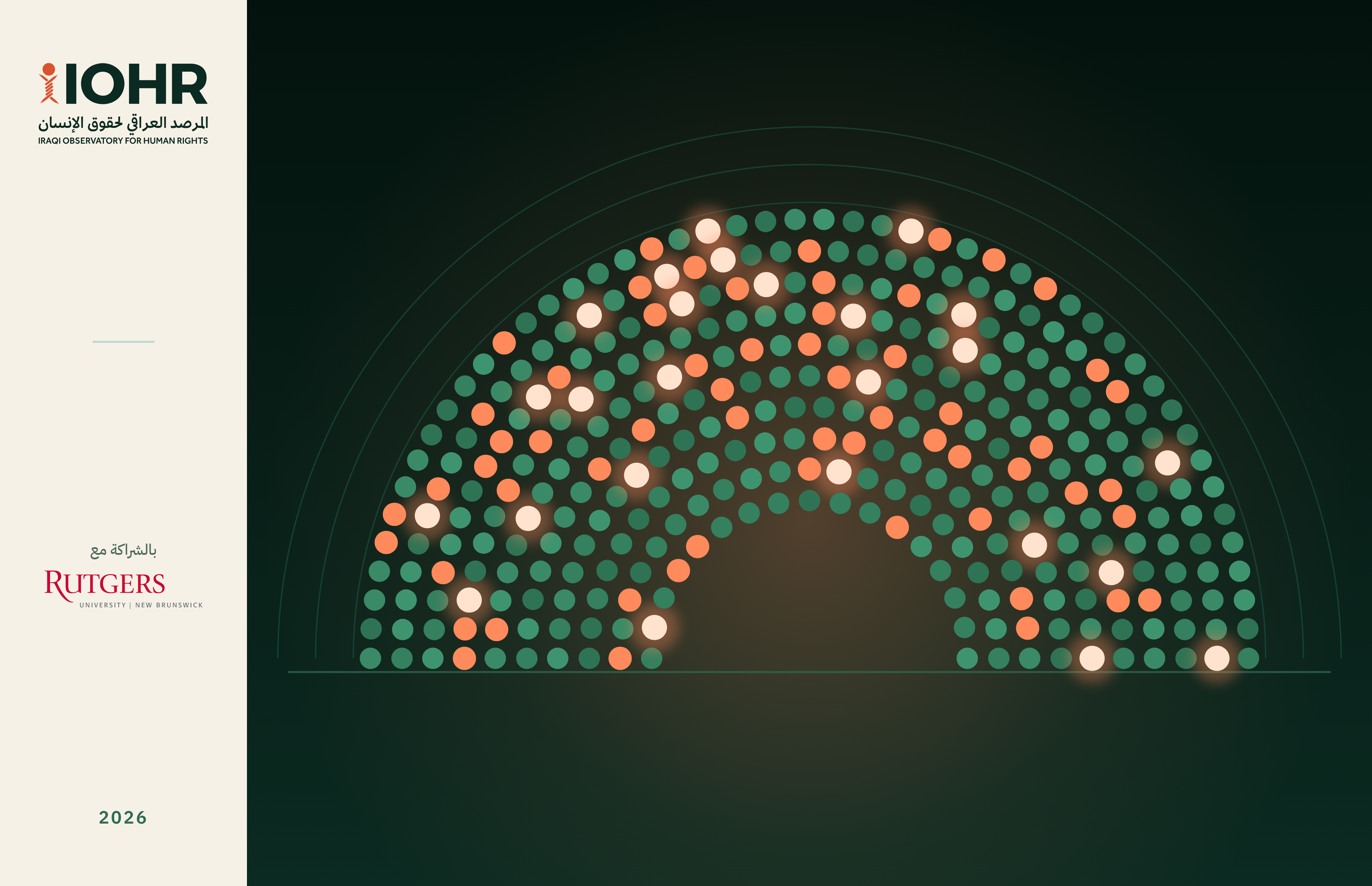

The Iraqi Observatory for Human Rights, as part of its Young Researchers Fellowship Program in partnership with Rutgers University, has published a field study by researcher Duha Mustafa Al-Ameri on why women in Iraq stall at the quota threshold. The study draws on fifteen in-depth interviews conducted in Baghdad in June and July 2024 with women in parties and movements and with independent candidates. It reads them against Inter-Parliamentary Union data, United Nations documents, CEDAW Committee observations, and the legal texts.
In the Transitional Administrative Law of 8 March 2004, and then in the 2005 Constitution, Iraq set a goal that women should hold no less than a quarter of the seats in parliament. Women’s share jumped from 7.6 percent in the pre-2003 parliament to 25.5 percent in the December 2005 elections. Then it stopped at the threshold. In five of six electoral cycles the share stayed between 25.2 and 25.5 percent. The only exception was 2021, at 28.9 percent. In the 11 November 2025 elections it returned to 25.5 percent, or 84 women out of 329 seats. After more than twenty years, no woman has chaired the Council of Representatives.
The study shows that the quota guaranteed women numbers but not power. It applies to parliamentary seats and provincial councils, not to the cabinet or to independent bodies.
Key findings:
By the numbers: Of the 84 women elected in 2025, only 25 won on their own votes, outside the quota. Women are 49.8 percent of Iraq’s population according to the 2024 census.
In government: The October 2022 cabinet included three women among 21 ministers, after two among 22 in 2020. The 2019 board of the Independent High Electoral Commission had one woman among nine members.
Inside the parties: Participants describe parties that control nominations, pick candidates who will stay loyal, use women’s votes for their blocs’ benefit, and keep their leaderships male.
Money and safety: Participants describe campaigns with no spending cap and an unsafe political and media environment. The United Nations documented that three women were among 22 targeted killings, within events in which 487 protesters were killed between October 2019 and April 2020.
The study makes ten recommendations. They include amending the Political Parties Law, clarifying that the quota is a floor and not a ceiling, setting a cap on campaign spending and providing supportive funding, creating mechanisms to protect women from political violence, passing the domestic violence law, adopting a media policy, reforming the composition of the Supreme Council for Women, publishing election data disaggregated by sex, and carrying out broader research outside Baghdad.
This is a qualitative study and it does not measure or generalize. It is limited to women inside party life in Baghdad and does not hear from voters, men, or rural women.